The Betrayal at Tenmoku Pass
still pool after fire,
a name dissolves in the cold,
and nothing is changed.
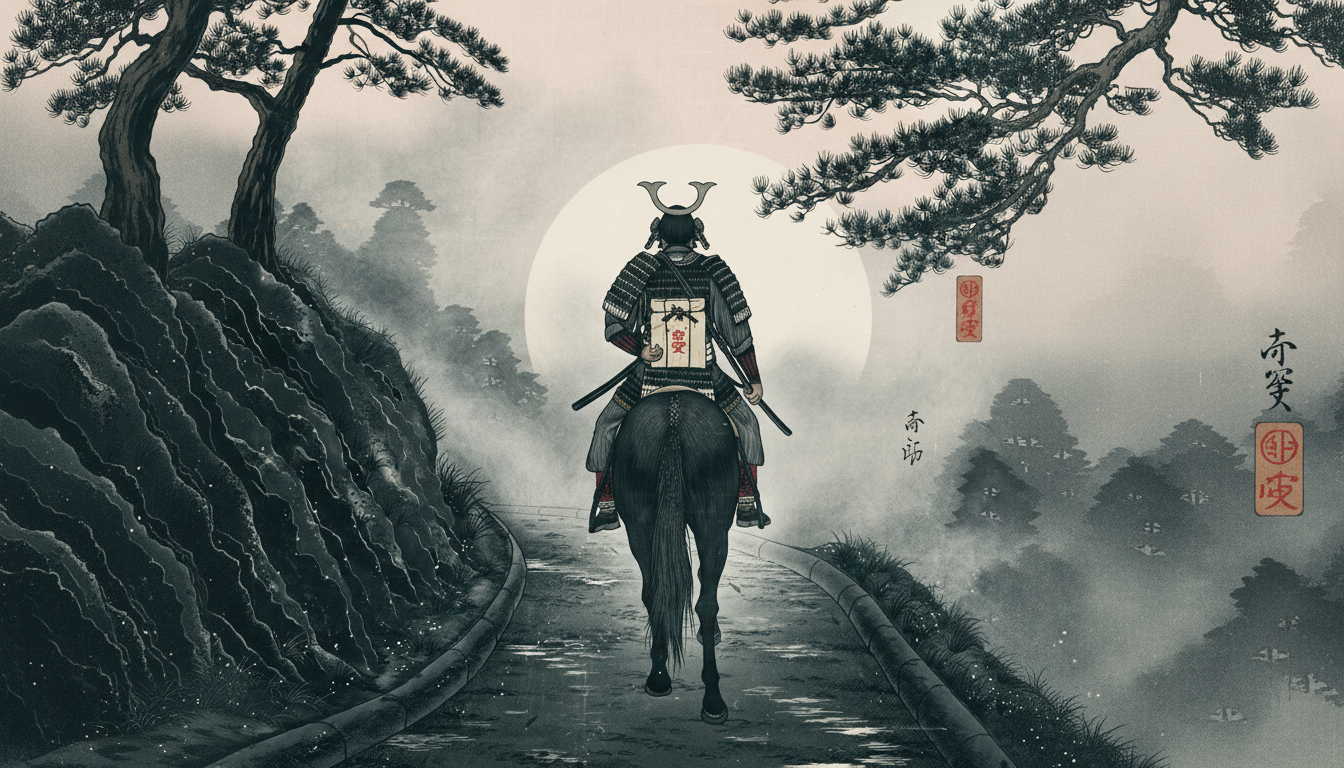
The fog closed around me like old silk. It caught on the pines, turned rock to ghost. Where the road narrowed to a dark seam along the mountain’s ribs, I let the horse slow. My cloak had taken on water until it felt like another skin. The horse’s breath rose and vanished. I watched it disappear and thought how easy it is for a thing to stop existing without anyone noticing. The mountain was quiet. That is how it listens.
I tied the horse to a low juniper when the path lifted onto a shelf of stone. The animal took the rope without argument. I climbed the few steps to a roadside shrine. Ivy had softened the wooden foxes until their snarls were only green lumps. Coins dulled the stone basin. Pine needles wrinkled the water’s skin. I wet two fingers and touched brow and lip. Habit, not belief. It is good to arrive with a gesture of order. Roads swallow men who arrive with nothing.
He was already there. Kuroda Jinzaburō sat at the verge as if the mountain had folded itself to make him a seat. The robe was the same patched gray as always. The staff looked like a pilgrim’s stick and felt, in memory, like a weapon. His head shone where the fog met skin. He watched the mist as if it were a page.

“Fukazawa Ren,” he said without turning. “You still ride as if you are being watched.”
“I am,” I said.
He smiled without teeth. “Yes.”
We let the fog speak. Drips from needles. A small roll of rock somewhere below. A single crow. I did not ask how he had found me. He found everyone. That is why he was not a name on a post.
“You said he would take this road,” I said. “Tonight.”
“He will,” the monk answered. “A man who sold his lantern must walk in darkness.”
“Hayashi Masanori is not a poet,” I said.
“No. But he loves being the subject of poetry.”
I looked past him into the pale. “Why here.”
“Because a pass is a throat,” he said. “Because both sides must breathe through it. Because on the far edge of this fog, he will not be the same man.”

He drew a circle in the wet grit with the staff, then placed a smooth river stone at the center.
“Oaths,” he said, tapping the stone. “Lines around emptiness. A man can sell the line and still believe in the circle.”
I watched the stone. I told myself to think of a blade, not a sermon. His words cling. Later, when the hand moves, the words can move with it.
“Who waits with him,” I asked.
“Enough to complicate your morality. Two ahead, two behind. A matchlock that sulks in damp powder. He will be late. A woman arrives first by another path.”
“A woman.”
“Grief travels faster than men,” he said. “She has debts to arrange.”
“Her name,” I said.
“She would not give me one.”
“Then you know it,” I said.
“I know many names,” he said. “I use them like charcoal. They stain the fingers.”
I let that pass. The fog pressed a cool palm against my face. My jaw loosened a finger’s width, then closed again.
“How much of this have you sold twice,” I asked.
“Enough that both buyers feel special. It keeps them from asking questions at the same time.”
I moved down the shelf to a shoulder of talus and a low rock outcrop. I crouched with the cliff at my back. Knees easy. The weight of the sheathed blade settling along the ground. Through the fog I could mark the broken watchtower by its shark teeth of stone. The road crossed there. Men who like to be seen always pause where the view can see them back.

Jinzaburō came after me, the staff making small notes on gravel. “A last thought,” he said. “Mountains remember nothing.”
I did not answer.
“They do not keep our names,” he said. “Nor our debts. If you kill him, you may feel something has been balanced. It has not.”
“Then why are you here,” I asked.
“To watch.” He smiled in a way a blade has two colors when a cloud moves.
He left me to the fog. I slowed my breath. I counted the pulse in my left thumb, then let numbers go. Water on needles. A far dog. The hush of mist against bark. Waiting empties a man in clean increments. I slid into it until my thoughts made less sound than the fog.
Bootsteps from the north. First three. Then more. A low voice. The tin click of a matchlock’s spring that hated its work today. My shoulders loosened. It would cough at the wrong time.
Before their steps, she came. I did not hear her until she had already passed my hiding place. She moved like someone trained to be unseen when it is necessary, not to be invisible always. That is the difference between servants and those whom servants obey.
She stood plain against the white. A travel cloak, a hood, layers of indigo any market could sell. Not Kyoto finery. Not peasant thread. Her shoulders were tired and still held straight by something that belonged to her.
She paused at the broken tower, a different sort of vanity. Turned her face toward the climb behind us. I saw a cheek line and the suggestion of a mouth that did not close itself softly.

The men followed. Four shapes. The sulking matchlock. A leader who walked half a pace ahead without making boast of it. Even before the fog thinned around him I knew him from the habit of his body. Hayashi Masanori. Taller than memory, which means straighter. Some men get height back when they decide they deserve it.
He stopped beside the woman. He looked past her at the broken stone the way a man looks past a reflection to the room behind it.
“You chose the pass,” he said. His voice had not changed. Smooth. The kind that convinces men to stand where arrows will find them.
“It is where you would come,” she said.
“And what you bring,” he said. “Will it keep men from reconsidering loyalties when crops come late.”
“The crops always come late to men like you,” she said. “You ask them to die for punctuality.”
One of his rear guard made a cough that wanted to be a laugh. The matchlock chewed at old powder.
“I did not sell Takeda for my life,” Hayashi said. “I sold him for Kai.”
I felt my hand on the scabbard’s throat. No anger. We have all heard sentences that ask us to become their furniture. The monk had made me fluent in such talk.
The woman touched the edge of her cloak. There was a fan at her waist. Black lacquer. Plain. Thick hinge. A fan that could speak to a room or to a throat.
“You led them into the river mouth,” she said, “and you did not count the mouths that swallowed them.”
Mud. Iron. Reeds breaking under boots. A friend’s name cut in half by the wet. He had led the charge with eyes fixed on the far bank, because commanders do not lower their eyes. Half the men went down to arrows they could not see. The living watched their dead and lost the bank again.
“The river takes what washes to it,” he said. “I did not call the rain.”
“Then do not call yourself the roof,” she said.
On the lower road I heard feet from the south. Quick and together. Earlier than Jinzaburō had guessed, or exactly on time if the mountain kept a different hour. I did not move. I let one sound settle next to the other.
“Speak your terms,” Hayashi said.
“I do not want your terms,” she said.
“Then you risk wind for the pleasure of it.”
“For clarity,” she said. “To hear you say it.”
“Say what.”
“That you belong to yourself more than any flag,” she said. “So I can stop thinking the world went mad for reasons beyond accounting.”
He considered that. There was a crack in the tower stone where a man might set one finger and feel his own pulse. He did not touch it. “We belong to the hand that feeds our children,” he said.
“Some of us belong to those children,” she said.
The south road delivered its men into the white. Their cadence was disciplined and uncertain at once, as if obedience were tinder in damp. Fog would hide their number until numbers meant nothing.
A belt hook clicked. The matchlock chewed another taste of powder and hated it. The soldier coaxed the coal. The mountain pressed damp into the pan like a housewife correcting a boast.
I rose.
I moved the way rock moves. You do not remember the moment when it changed its place, but you see it somewhere else and accept it. I stepped into the road. Three paces from the broken tower. Five from Hayashi. Four from the woman. My scabbard brushed the stone. The sound rang clear and small. Every present intention turned to find its angle. Angles opened like doors.
Hayashi’s hand did not go to his sword. He has always been good at time.
“Fukazawa,” he said. Not surprise. Not greeting. A note made with a small brush.
I bowed. Not for him. For my spine. “Masanori-dono.”
The woman looked between us one time and then looked at my feet. You can tell a fighter by the way he stands without claiming the ground. She moved half a step as if to make room for a stream.
“What do you want,” he asked.
“You,” I said.
“Dead.”
I considered the fog. “To answer.”
“To yourself or to the world,” he asked.
“To the men whose names are not written anywhere,” I said.
He smiled the smile that comes as easily as breath to a man who has worn it too long. “They have wives to speak them.”
The fog eased its grip. The broken tower showed another tooth. The men from the south were almost upon us. Shapes inside shapes. Guilt arrives like that, with a fine excuse, then becomes the only story you can tell.
“You can walk down,” I said. “You can walk down and never speak again. Or you can stay, and I will make silence of you here.”
“An appalling choice,” he said. “Silence either way.”
“Suitable for mountains,” I said.
The woman’s fingers touched the fan. “He will not go down,” she said. “He loves being seen.”
He nodded to her, as if one actor acknowledged another.
“Shall we pretend I have men who will fight for me,” he asked.
“You have men who will die near you,” I said.
The matchlock man swore softly to the iron on his shoulder. The newcomers reached the edge of our arrangement, stopped, then spread the way water spreads when a jug breaks. The fog did the work of confusion. Someone shouted a name that might have been a command. Someone else shouted move, which is the opposite of a plan.
“Good,” Hayashi said. “Company makes honesty easier.”
He drew his sword. The noise was small and kind. I drew mine. Two facts recognized one another.
Steel tilted in white air. The woman stepped back two paces. The men behind Hayashi shifted in the habit of becoming the shadow of something they could not name. From the south a captain, if breath can wear rank, began to add his figures too slowly.
“You followed me because you needed an ending,” Hayashi said.
“I followed you because you wrote mine,” I said.
“I wrote many,” he said, and came forward.

My body moved before I remembered deciding. The fog thickened, or perhaps I was inside my own breath. His sword met mine, old rhythm, old noise. For a moment it was only training. Then his face was close enough to read. I did not like what I saw. He still loved the finish.
He was better than I wanted him to be. Nothing wasted in his stance. His cut came from behind the heart. Clean. Unadorned. A movement that makes witnesses think of a door opening, not of harm. I answered with economy. Our blades spoke once, then again with less courtesy.
Fog closed, reopened. The men around us blurred into intentions. The matchlock finally bit fire into its charge. The shot boomed and threw echoes into the pass and killed nothing anyone would miss. Smoke folded into fog like cousins relieved to be together. A man from the south slid on his own fear and stayed where he fell.
Hayashi pressed. I gave two steps, reclaimed one. Fighting takes the sound out of weather. The fog watched without voice. I felt the edge of the road under my heel, the shape of the rock to my left, the small place where a foot should not go, and found that my body preferred not to fall today.
I waited. Ambition runs out sooner than patience. He liked a clean finish. When it did not present itself, he came to take it. I let him see a slight opening, just enough. Then I closed it. Not with flourish. With a small refusal that made him add more than he meant to add. Our blades bound. For one breath we were married. I shifted my hands the width of a grain of rice. The binding became a hinge. The hinge opened. I stepped through and returned the smallest gift a sword can give.
His mouth made no sound. His face showed surprise without complaint. He looked down, as men do, to where warmth becomes warmer. He reached for that place with the courtesy of a man adjusting his sash in company.
He went to his knees. Then to both hands. Then he lay upon his breath. The fog touched his hair like a mother combing a child.

The men behind him hesitated. The men before him did the same. A silence passed from one to the next, like a cup being tested for how full it is. The matchlock man stared at his weapon as if he had finally understood something and wished he had not.
The woman did not move.
Jinzaburō came out of the fog as if he had been hiding inside its sleeve. He looked at the body with a scribe’s attention, the kind you give a page you have copied correctly. Accuracy can be boring.
I lowered the blade and angled the point toward a patch of gravel without blood. I breathed once. It tasted like air that had lived in Hayashi a moment ago and now had no home.
“You have your answer,” the monk said softly.
I said nothing.
“Does it rearrange your dead,” he asked.
I wiped the blade on my cloak’s hem and sheathed it. The sound was a lid on a small box.
Below us, the southern captain found his spine and shouted back in a voice that did not belong to any clan in particular. Men obeyed because retreat feels less like choosing than anything else.
The woman crouched beside Hayashi. She did not touch him. She tilted her head as if listening for what he had forgotten to say. Then she stood.
“You are faster than grief,” she said.
“No,” I said. “Grief likes to be followed.”
She weighed me the way a shopkeeper weighs a blade that has not been named or bought. I turned slightly to keep both her and the monk inside the same portion of sight.
“You came to hear him say the world is made of rice,” she said. “Men like him always say that. Men like you must cut their tongues to taste something else.”
I could not tell whether she praised or condemned me. Perhaps both. I nodded as if she had given a task.
“The south road will bring more,” Jinzaburō said. “This place will fill with opinions.”
She looked at him. “You arranged this.”
“I sold the wind directions,” he said. “The mountain arranged the rest.”
“I have children to move,” she said. “Not mine. The last of a house.”
“Children are heavy,” the monk said. “Even when they try to be light.”

She glanced toward the path behind the shrine. “There is a woodcutter’s cut down the slope. No one remembers it.”
“I remember it,” he said.
“Of course,” she said, and one corner of her mouth admitted being human.
She adjusted her cloak and moved toward the shrine. No thanks. No warning. I did not follow. I did not stay. I took three steps away from the road to a hollow where water collected. A small pool with a skin of pine oil. My face wobbled there, then lost itself.
I knelt and scrubbed the blood from my knuckles. The cold bit me back to a narrower present. I cupped water to my mouth. The taste was clean. It changed nothing.
A crow watched from a burned snag above the path. It tipped its head with the seriousness of a judge. The fog lifted enough to show the valley’s smudged greens and the strip of river cutting small parentheses around reeds. A wind came that could not decide which season to serve. The long grass bowed and forgot to stand again.

Jinzaburō stood with his staff near my shoulder. “Balance,” he said, the way a man warns another that a step is not where a road pretends to be.
I stood. I did not look at him. I did not look at the woman’s retreat or the men sorting their courage or at the body on the road. I watched the pool until the ripples were gone. Then I watched nothing.
At the shrine I placed a coin in the basin. Not because gods count. Because men do. The coin settled among the others and did not know the difference between prayer and habit.
I went to the horse. I laid a palm on the neck for the brief apology neither of us needed. I mounted. The leather creaked like old advice.
I rode south. Not to follow the woman. Not to escape the men. Because a road is an instruction until you refuse it. I did not yet know how to refuse.
The fog lifted in sheets. The mountain kept its indifference. Above the broken tower a small wind turned ash into air.